How to Read an Eyeglass Prescription: SPH, CYL, AXIS & ADD
Learn how to read your eyeglass prescription, including SPH, CYL, AXIS, ADD, PD and prism values, with clear examples before ordering glasses online.
On a typical eyeglass prescription, OD (Oculus Dexter) refers to the right eye and OS (Oculus Sinister) to the left eye. Common fields include SPH, CYL and AXIS; some prescriptions also include ADD, PD and Prism.
Prescription Example: Where to Find Each Value
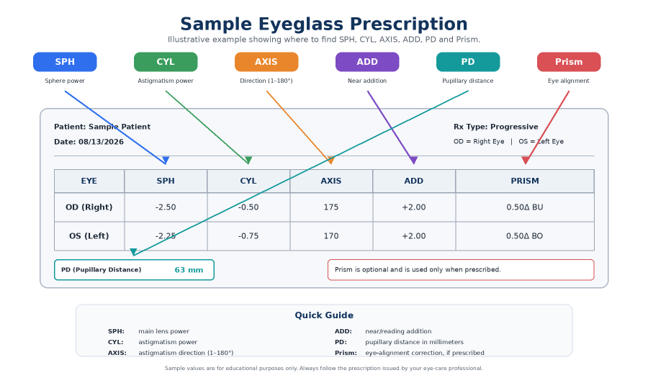
Illustrative sample only. Your prescription values and format may look different.
For Distance Correction
Distance prescriptions normally include SPH for each eye. If astigmatism correction is needed, CYL and AXIS are also listed. D.V. may be used for distance vision.
For Reading-Only Correction
Reading prescriptions may list near-vision powers directly or use a distance prescription plus ADD. Enter the values exactly as written; do not estimate or convert them yourself.
For Astigmatism Correction
CYL and AXIS work together. If CYL is present, there should normally be a corresponding AXIS value.
- Check the plus (+) or minus (-) sign carefully.
- If there is no astigmatism correction, CYL/AXIS may be blank or marked SPH/DS.
- AXIS is a whole number from 1 to 180; 5, 005 and 5° mean the same axis.
For Bifocals and Progressive Lenses (ADD)
ADD is extra plus power for near vision. If one ADD value is shown, it commonly applies to both eyes unless noted otherwise. “PAL” may indicate progressive addition lenses. Viewner processes ADD powers from +1.00 to +3.50.
How to Read PD (Pupillary Distance)
PD centers the lenses in front of your eyes. It may be shown as one total PD (for example, 63 mm) or two separate monocular PD values.
- If PD is not listed, use an accurate PD measurement before ordering.
How to Read Prism
Prism is not included on every prescription. When prescribed, it may be written in prism diopters (Δ) with a base direction: BU, BD, BI or BO.
- Enter prism exactly as written. If it is unclear, confirm it before placing the order.
Important Notes Before Entering Your Prescription
- Check every plus (+) and minus (-) sign carefully.
- Do not guess if a decimal point, handwritten number or abbreviation is unclear.
- Make sure OD values are entered for the right eye and OS values for the left eye.
- If you are unsure about SPH, CYL, AXIS, ADD, PD or Prism, send a clear photo of the prescription to Customer Service.
Need Help Reading Your Prescription?
If anything on your prescription is unfamiliar, please contact the Viewner Customer Service team. We can help you identify the fields before you enter the prescription online.