Low Bridge Fit vs Standard Fit: Which Glasses Fit Is Right for You?
Frame style matters, but the right fit matters even more. If your glasses slide down, touch your cheeks, or sit too close to your eyes, the bridge fit may be the reason. This guide explains how to tell whether standard fit or low bridge fit is likely to work better for you.
Low Bridge Fit vs Standard Fit at a Glance
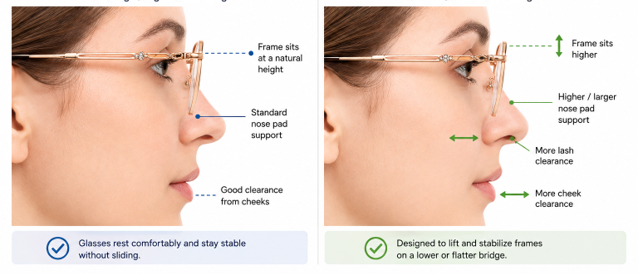
What Is Standard Fit?
Standard fit glasses are designed for people with a higher or more defined nose bridge. The frame can rest naturally on the nose, keeping the lenses centered and at a comfortable distance from the eyes.
- Your nose bridge is higher or more defined
- Your glasses do not slide down easily
- The frame does not rest on your cheeks when you smile
- Your eyes sit near the center of the lenses
- Regular adult glasses usually fit you well
What Is Low Bridge Fit?
Low bridge fit glasses are made for people with a lower, flatter, or less pronounced nose bridge. They can also be helpful for higher cheekbones. These frames may use larger or higher nose pads, a different bridge shape, or an adjusted front angle to help the glasses sit higher and reduce sliding or cheek contact.
- Your glasses often slide down your nose
- The frame touches your cheeks when you smile
- Your nose bridge is lower, flatter, or less pronounced
- Your eyelashes touch the lenses because the frame sits too close
- Standard frames feel loose, low, or unstable
Low Bridge Fit vs Standard Fit: Main Differences
| Fit Point | Standard Fit | Low Bridge Fit |
|---|---|---|
| Best for | Higher or more defined nose bridges | Lower or flatter nose bridges; often helpful with higher cheekbones |
| Frame position | Sits naturally on the nose | Designed to sit higher and more securely |
| Sliding | Works well when the bridge supports the frame | Can help reduce slipping and a low frame position |
| Cheek contact | Usually clears the cheeks | Designed to create more clearance from the cheeks |
| Nose support | Regular bridge geometry may be enough | Often benefits from higher/larger or adjustable nose pads |
How to Tell Where Your Nose Bridge Sits
Do not rely on face shape or ethnicity alone. The easiest way to judge bridge fit is to look at how a regular pair of glasses actually sits on your face.
- Start with the right overall frame width. If the frame is much too wide, temple fit can cause sliding even when the bridge itself is suitable.
- Look straight ahead, then smile and blink. A good bridge fit stays centered; cheek contact or eyelashes brushing the lenses suggests the frame sits too low or too close.
- Wear the glasses for 5–10 minutes. Repeated downward sliding when the temples are not obviously loose is a strong low-bridge-fit clue.
- Do not judge by the bridge number alone. Frames with the same bridge measurement can fit differently because bridge shape, nose-pad height, front angle, and lens height also matter.
Fit Problem Checklist: What Your Glasses Are Telling You
| What you notice | What it may mean | What to try |
|---|---|---|
| Glasses keep sliding down | The bridge or nose pads may not be giving enough support; the frame may also be too wide. | Try a low-bridge-friendly frame, higher/larger adjustable nose pads, or a better-matched frame width. |
| Eyelashes touch the lenses | The frame is sitting too close to the eyes or too low on the bridge. | Look for more nose-pad height, adjustable pads, or a frame angle that creates more eye clearance. |
| The frame presses or lifts on your cheeks when you smile | The frame may be sitting too low, or the lens height/front angle may not suit your cheekbones. | Consider low bridge fit, a slightly shallower lens shape, or more nose support. |
| Nose feels pinched or develops deep marks | The bridge may be too narrow or the nose pads may be set too tightly. This is not automatically a low-bridge issue. | Try a wider bridge or have adjustable nose pads professionally repositioned. |
Low-Bridge-Friendly Frames to Consider at Viewner
Important: Viewner does not currently label these four frames as a dedicated “Low Bridge Fit” collection. They are practical candidates because their product pages or customer reviews mention adjustable nose pads, low-bridge comfort, or reduced slipping. Always compare frame width and measurements with a pair that already fits you.
- Mateo Polygon Rose Gold Eyeglasses — Best-supported option for this guide: the page includes a customer review specifically mentioning a lower nose bridge and saying the adjustable nose pads helped the frame stay in place.
- Glimmer Silver Oval Eyeglasses — A lightweight oval option with customer feedback mentioning adjustable nose pads and a stable, no-slip feel.
- Fame Black Silver Square Eyeglasses - Check the product page for frame measurements and fit details.
- Steven Rectangle Golden Eyeglasses — The product description states that it includes adjustable nose pads for a custom fit. Its 15 mm bridge is relatively narrow, but the large overall frame width should still be checked carefully.
Related Fit Guides
- Best Glasses for Small Faces — useful if slipping is caused by an oversized frame rather than bridge design alone.
- How to Choose Glasses Lenses — helps match frame fit with lens type, coatings, and index.
Which Fit Should You Choose?
Neither fit is better for everyone. Choose the frame that stays centered, feels secure without pinching, leaves enough space for your eyelashes, and does not rest on your cheeks when you smile. If regular adult frames already do this, standard fit is probably the simpler choice. If they repeatedly slide or sit too close to your face, low bridge fit or a frame with adjustable nose pads may give you a better starting point.
When buying online, check the bridge design, nose pads, total frame width, lens width, and lens height together. If you are between fits, compare those measurements with a pair you already wear comfortably.
FAQ
Fit note: Frame fit is individual. For persistent discomfort or significant frame adjustment, an optician can help fine-tune nose pads, temples, and alignment.